
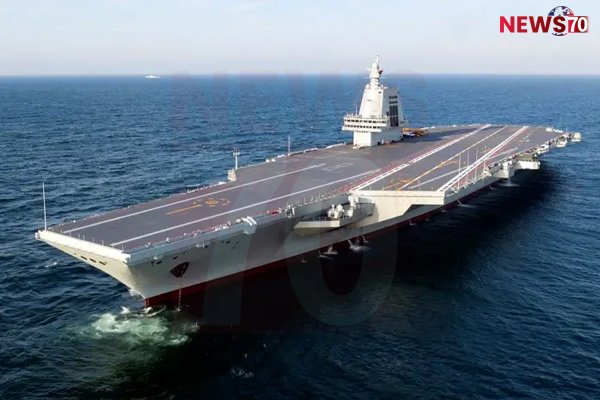
China’s most advanced aircraft carrier, the Fujian, has entered service under President Xi Jinping’s oversight. Equipped with electromagnetic catapults, it can launch multiple aircraft types with heavier payloads, boosting China’s naval capabilities and signaling strategic power projection in the Indo-Pacific.
China’s most advanced aircraft carrier, the Fujian, has officially entered service, just days after a grand commissioning ceremony attended and overseen by Chinese President Xi Jinping, state media reported.
The Fujian, China’s third aircraft carrier, is equipped with electromagnetic catapults, enabling aircraft to launch at significantly higher speeds compared to conventional steam catapult systems. This technological advancement represents a major leap for Beijing, which now operates the world’s largest navy by total number of ships.
Under Xi Jinping, China has been rapidly expanding its naval capabilities, intensifying pressure on the United States and its regional allies to maintain military parity in the Indo-Pacific.
According to state media, the Fujian’s electromagnetic catapult and flat flight deck allow it to launch three different types of aircraft, including fighters, surveillance planes, and drones. Being domestically built, the vessel can carry aircraft with heavier weapons and fuel loads, giving it the ability to strike enemy targets at greater distances, making it considerably more capable than China’s first two carriers, the Liaoning and the Shandong, which were based on Russian designs.
Chinese state media described the Fujian as a “major milestone” in the development of China’s navy, highlighting the carrier as a symbol of the country’s growing maritime power. Currently, only the United States operates aircraft carriers with a comparable electromagnetic catapult system, underlining China’s growing technological parity with Washington in naval warfare.
The commissioning ceremony took place in southern Hainan province on Wednesday. During the event, Xi toured the ship’s flight deck and operational areas to receive briefings on its performance, capabilities, and readiness for deployment. Reports stated that Xi personally approved the adoption of electromagnetic catapult technology for the Fujian, demonstrating his hands-on approach to China’s naval modernization.
State media also highlighted that Xi interacted with sailors lined up along the deck and dock, who saluted and chanted in unison: “Follow the party’s command, fight to win, and uphold fine conduct!” This underscored the political and military symbolism of the carrier as both a technological achievement and a tool for reinforcing loyalty to the Communist Party of China.
The Fujian is expected to strengthen China’s power projection capabilities in the South China Sea and beyond, allowing it to conduct extended operations and assert its influence in contested maritime regions. Analysts suggest that its deployment is a clear signal to both regional and global powers that China is serious about naval modernization and strategic dominance in the Indo-Pacific.