
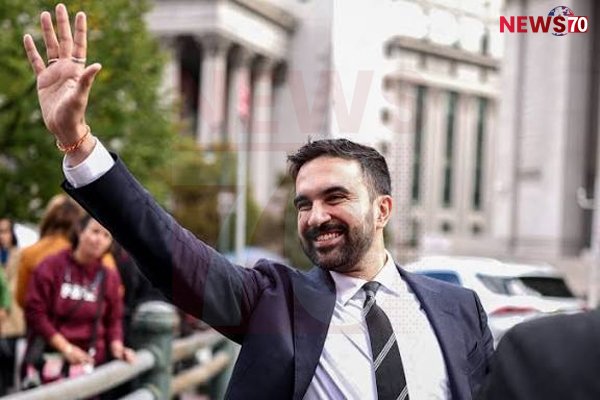
Zohran Mamdani, 34, a Ugandan-born democratic socialist, is projected to win the New York City mayoral election, defeating Andrew Cuomo. His historic victory makes him the first South Asian and Muslim mayor of NYC. Focused on affordability and social programs, his rise marks a shift in Democratic Party politics and signals new energy among young, progressive voters.
Zohran Mamdani projected to win New York City mayoral election
Zohran Mamdani, 34, is the projected winner of New York City's race for mayor in a contest that rallied young voters and sparked debate about the future direction of the Democratic Party.
The Ugandan-born Mamdani, a Democrat, beat former New York Governor Andrew Cuomo, running as an independent, to become the youngest person in over a century to lead the largest city in the US.
A self-described democratic socialist, he made affordability the central message of his campaign, pledging to expand social programmes paid for by new taxes on high earners and corporations.
Mamdani was a relatively unknown member of New York State Assembly until his campaign gained online momentum a few months ago, propelling him to victory in the Democratic primary contest over the summer.
His campaign has drawn significant national attention, including from US President Donald Trump, who in the days before the vote threatened to withhold federal funds from New York if Mamdani, whom he called a communist, won.
It is a historic moment as Mamdani also becomes the first South Asian and Muslim to lead the city.
But there are questions over how he will pay for his ambitious social agenda and critics have questioned how a politician with no executive experience will handle a hostile Trump administration.
His win also presents a dilemma for the Democratic establishment, which has been reluctant to endorse him.
Centrist Democrats clinched victories in elections for governor on Tuesday night, with US Representative Abigail Spanberger and US Representative Mikie Sherrill winning races to run the states of Virginia and New Jersey respectively.
Mamdani was the favourite to win New York City's election, leading Cuomo and Republican Curtis Sliwa in the polls by double digits for weeks leading up to Election Day.
A relatively unknown figure just months ago, few could have predicted his rise, from hip-hop artist and housing counsellor to the frontrunner to lead a city with a $116bn (£88bn) budget and global scrutiny.
The former New York assemblyman centred his campaign on affordability in one of the country's most expensive cities, campaigning on issues like universal child care, and free and faster buses.
His candidacy drew criticism from business leaders and centrist Democrats, some of whom did not endorse him, including fellow New Yorker and Senate Minority Leader Chuck Schumer.
Republicans have seized on his expected win to paint the future of the Democratic Party as a party of socialism. President Donald Trump has repeatedly lambasted Mamdani and threatened to withold federal funding from the city if he wins.
Still, Mamdani won even after New York Mayor Eric Adams dropped out of the race after several scandals, which was expected to boost Cuomo's candidacy. Remix it
ChatGPT said:
Sure — here’s a remixed version of that news story with a more dynamic, narrative tone and tighter flow, while keeping all the key facts and structure intact:
Zohran Mamdani Makes History as Projected Winner in New York City Mayoral Race
Zohran Mamdani, 34, is projected to become the next mayor of New York City — a stunning rise for the Ugandan-born Democrat who campaigned on a promise to make the city more affordable for working people.
The self-described democratic socialist defeated former New York Governor Andrew Cuomo, who ran as an independent, to become the youngest person in more than a century to lead America’s largest city. Mamdani also marks a historic first — the city’s first South Asian and Muslim mayor.
Once a relatively obscure member of the New York State Assembly, Mamdani’s campaign caught fire online over the summer. Energized by young voters, his message of social investment and economic equity turned a long-shot bid into a national phenomenon.
Affordability was at the heart of his campaign. He vowed to expand social programs and improve public transit, funded by higher taxes on the city’s wealthiest residents and corporations.
His rise has sparked fierce debate within the Democratic Party. While progressives hailed his victory as a sign of generational change, centrist Democrats kept their distance. Senate Minority Leader Chuck Schumer, among others, declined to endorse him.
National attention intensified in the final days before the election when President Donald Trump warned he would withhold federal funds from New York if Mamdani — whom he labeled a “communist” — won. Despite the threats, Mamdani maintained a commanding lead in the polls, outperforming both Cuomo and Republican Curtis Sliwa by double digits.
His triumph stands in contrast to results elsewhere, where centrist Democrats such as Representatives Abigail Spanberger and Mikie Sherrill secured gubernatorial victories in Virginia and New Jersey.
Mamdani’s win signals a major shift in New York politics — and perhaps the Democratic Party at large. Yet challenges loom: critics question how he will pay for his ambitious agenda and whether his limited executive experience will prepare him for clashes with a likely hostile Trump administration.
A former hip-hop artist and housing counselor, Mamdani’s journey from community advocate to City Hall underscores a new political moment — one driven by grassroots energy and a demand for change in one of the world’s most expensive cities.