
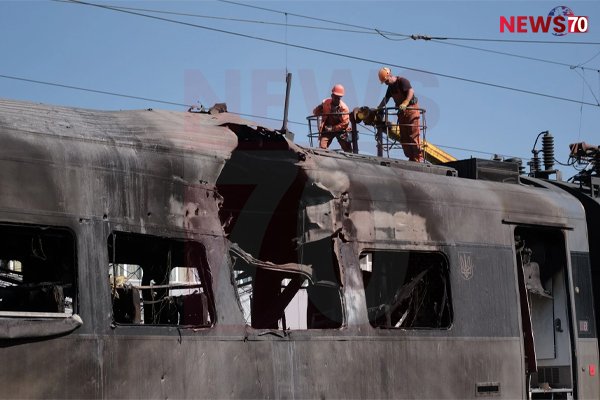
Russia has intensified drone strikes on Ukraine’s railway system, targeting vital transport infrastructure and passenger trains in what officials call a “battle for the railways.” Railway workers like Olha Zolotova have been severely injured in recent “double tap” attacks, while Ukraine scrambles to repair damage, maintain morale, and keep the country moving. Officials warn the strikes aim to cripple logistics and morale as Ukraine faces its fourth wartime winter, urging allies for stronger air defense systems.
Ukraine’s ‘Battle for the Railways’: Inside Russia’s Escalating Drone Strikes on Trains
Propped up in a hospital bed, railway conductor Olha Zolotova speaks softly as she recalls the day her train was struck by a Russian drone.
“When the Shahed [drone] hit, I was buried under debris. I was in the second carriage. People pulled me out,” she says quietly.
“My vision went dark. Flames were everywhere; everything was burning. My hair even caught fire. I couldn’t move—I was trapped.”
Olha is one of many victims of Russia’s increasingly frequent assaults on Ukraine’s railway system — a crucial network that has kept the nation moving for three and a half years since Moscow’s full-scale invasion.
Spanning 21,000 kilometers (13,000 miles), Ukraine’s railway is more than transportation; it is a backbone of the country’s war effort and a symbol of national resilience.
Because her injuries were severe, Olha was transferred over 300 km (185 miles) to a specialized hospital in Kyiv for railway workers. She recently underwent hip surgery and had a metal plate inserted in her leg.
Her train was attacked earlier this month at a station in Shostka, in northern Sumy region. As rescuers tried to help the wounded, a second Russian drone hit the same station — a so-called “double tap” strike.
Ukrainian officials say civilians and emergency workers were deliberately targeted, calling it a possible war crime under international law.
In total, 30 people were injured. Among those hospitalized were three children, and one man died, reportedly from a heart attack.
According to Ukrzaliznytsia (UZ), the national rail operator, September saw twice as many attacks as August — not only on trains but also on supporting rail infrastructure.
Deputy Transport Minister Oleksiy Balesta says that half of all railway attacks since the start of the war occurred in just the past two months.
“Almost every day for the last two months, we’ve faced direct attacks on Ukrzaliznytsia facilities and on power transmission lines,” Balesta says.
He adds that Russia appears to be “hunting for locomotives”, deliberately striking both freight and passenger trains.
Standing behind him is a wrecked intercity locomotive, destroyed in eastern Kyiv during a devastating late-August assault. That same night, Russian strikes also hit a major rail junction in Koziatyn, central Vinnytsia region, causing long delays and forced diversions.
While speaking, Balesta receives a message: another train between Kramatorsk and Sloviansk — near the eastern front line — has just been hit.
Earlier in the day, three separate bomb threats were reported on other routes, prompting evacuations until explosive experts declared them safe.
Officials cite two main reasons behind the surge in attacks: Russia’s expanded drone production capacity, allowing the launch of large numbers of Shahed-type drones capable of flying longer distances, and the stalled front line, which has shifted Moscow’s focus toward disrupting Ukrainian supply routes.
“This is clearly a battle for the railways,” says Oleksandr Pertsovskyi, CEO of Ukrzaliznytsia. “The enemy is trying to paralyze us — to sow panic, cripple our economy, and make the country unlivable.”
Ukraine’s response, he explains, includes rapid repair operations, coordination with the military, and intensive training to detect sabotage.
“We always have Plans B, C, and D,” Pertsovskyi adds. “The goal is never to cancel a single route. If a train can’t run, we combine trains and buses.”
Maintaining passenger morale is also part of the strategy.
“Recently, a train from Kyiv to Sumy had to be rerouted, adding six hours to the trip,” Pertsovskyi recalls. “A passenger posted online that she’d spend her birthday on the train instead of with her boyfriend — but said she understood. We sent her a cake and flowers.”
With missile and drone threats making air travel nearly impossible, railways remain the lifeline for people, supplies, and exports — from grain and iron ore to diplomatic visitors.
Foreign leaders entering Ukraine now do so by train — a practice Ukrainians proudly call ‘iron diplomacy.’ The railway workers caught up in attacks are honored as ‘iron heroes.’
At Kyiv’s central station, a ceremony honors the latest group of Iron Heroes who battled fires after the intercity depot attack.
“It was terrifying — there was fire and destruction everywhere,” says Oleksandr Leonenko, one of the firefighters, proudly showing his certificate of bravery, which also comes with extra pay.
The surge in railway strikes has coincided with renewed Russian attacks on Ukraine’s energy grid, which recently left hundreds of thousands without power.
In retaliation, Ukraine has targeted Russian oil refineries, claiming to have caused fuel shortages across multiple regions.
As Ukrainians brace for their fourth wartime winter, Pertsovskyi warns that these infrastructure strikes could make it the toughest yet.
Echoing other officials, he urges allies to provide stronger air defenses.
“But we’re not broken,” he says. “We’re preparing mentally and practically. Ukrainians remain strong in spirit.”
That resilience, he adds, is about to face its greatest test yet.