
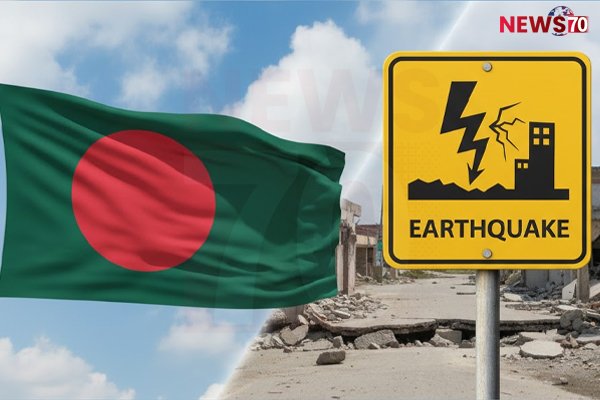
Experts have long warned that Bangladesh, situated on three tectonic plates, faces a major earthquake risk that could exceed magnitude 9. Dhaka is especially vulnerable, with studies showing that half of its buildings could collapse in a massive quake. Despite repeated alerts, the country’s disaster preparedness remains poor. Officials claim steps are being taken, but experts urge stronger urban planning, building codes, and public awareness to mitigate potential devastation.
For years, experts have repeatedly sounded the alarm about the risk of a devastating earthquake in Bangladesh, a deltaic nation located in Southeast Asia. Among the most vulnerable areas is the capital city, Dhaka, which could face catastrophic destruction if a major quake strikes. Despite these persistent warnings, the nation’s preparedness and capacity to respond to or recover from such a disaster remain alarmingly inadequate.
Bangladesh’s position at the junction of three active tectonic plates has long made it a high-risk seismic zone. Specialists caution that an earthquake exceeding magnitude 9 on the Richter scale is within the realm of possibility. Although the issue has been discussed extensively, concrete progress in disaster readiness has been minimal.
In recent years, small to moderate tremors have been felt both inside Bangladesh and in surrounding regions — including several that rattled Dhaka’s high-rise buildings and caused brief panic among residents. These frequent vibrations not only alarm the public but also weaken existing structures. Experts say the country’s geological composition further amplifies these dangers. Seismologist Professor Syed Humayun Akhter notes that the convergence of three tectonic plates beneath the region has placed Bangladesh under serious and continuous seismic threat.
Professor Mehedi Ahmed Ansari from the Department of Civil Engineering at BUET has issued a grave warning about Dhaka’s vulnerability. His studies reveal that nearly half of the capital’s buildings could sustain severe damage or collapse in the event of a major earthquake.
Disaster management professionals agree that Bangladesh is woefully underprepared for such large-scale natural disasters. Professor Khondaker Mokaddem Hossain, a disaster management expert, points out that “Bangladesh lacks even 20 percent of the capacity required to handle a major earthquake.”
The Fire Service and Civil Defence department, however, maintains that it is taking steps toward better preparedness. Lieutenant Colonel Mohammad Tajul Islam Chowdhury, Director (Operations), explained that new operational protocols are being developed to address earthquake scenarios and improve response mechanisms.
Experts unanimously stress that to reduce potential devastation, Bangladesh must urgently focus on earthquake-resilient urban planning, enforce stricter building codes, and enhance public awareness and training. Only through coordinated action and long-term planning can the nation hope to withstand a disaster of this magnitude.