
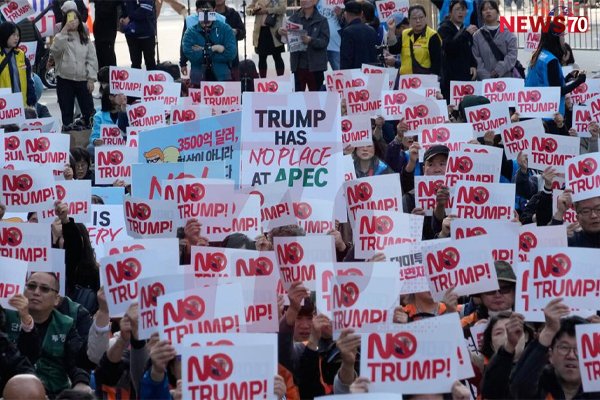
South Korea faces a delicate diplomatic balancing act as President Lee Jae Myung hosts both U.S. President Trump and China’s Xi Jinping. Protests in Seoul reflect public tensions, while Lee navigates trade, security, and North Korea diplomacy without alienating either superpower.
‘No Trump! No China!’: South Korea Navigates Superpower Rivalries
Hundreds of protesters in Seoul shouted “No Trump!” as they approached the U.S. embassy, their voices amplified over Gwanghwamun Square, while police buses blocked direct access. Nearby, another group rallied against China, holding banners reading “No China” and “CCP Out!” The protests, though relatively small by South Korea’s standards, underscore the delicate diplomatic balancing act President Lee Jae Myung faces this week as he hosts both U.S. and Chinese leaders.
Seoul remains a key U.S. ally, forged during the Korean War, yet it relies heavily on China for trade. Analysts note that Lee is maneuvering between economic integration with both superpowers, hosting discussions that may involve a potential breakthrough in the U.S.-China trade war.

Lee, a seasoned politician, faces challenges stemming from his predecessor Yoon Suk Yeol’s tumultuous tenure, which included martial law controversies, impeachment, and political polarization. While South Korea attempted to appease Trump with $350 billion in U.S. investments and $100 billion in LNG purchases, events like the detention of over 300 South Koreans at a Hyundai plant in Georgia have strained ties. Many South Koreans, however, still view the U.S. as their primary ally, while opinions on China remain mixed, with one-third seeing it as a major threat.
Anti-China sentiment has grown since 2016, particularly among conservatives concerned about CCP influence. Protesters carried signs calling for the protection of South Korea and resistance to Chinese interference, though these voices represent a minority of the electorate. President Lee has introduced legislation to curb rallies promoting hate or discrimination and has signaled his intent to maintain pragmatic ties with China. Xi Jinping is scheduled to meet Lee during his first visit to South Korea in 11 years.

Meanwhile, Trump’s visit remains short and high-stakes, with trade negotiations ongoing but unlikely to conclude quickly. Analysts suggest that a brief visit might be the most favorable outcome for Seoul, given the heavy economic and security stakes.
Xi’s longer presence in South Korea provides an opportunity for China to present itself as a stable trade partner, potentially helping Lee advance dialogue with North Korea. Lee’s Democratic Party has historically facilitated U.S.-North Korea engagement, but Pyongyang has not confirmed talks with Trump.
As South Korea reasserts itself as a wealthy, culturally influential nation, President Lee must carefully navigate relations with both global powers without alienating either, all while managing domestic opinion and ensuring national prosperity.