
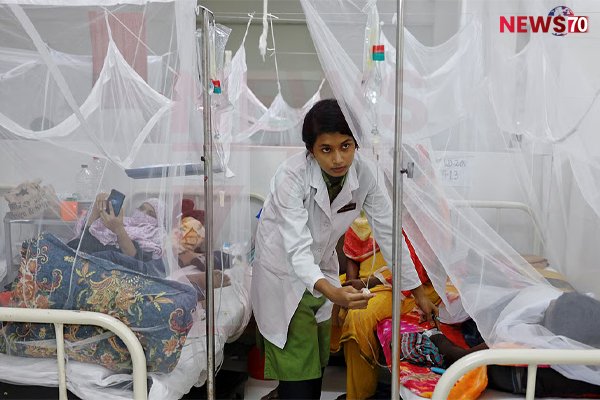
Dengue cases are overwhelming Shaheed Suhrawardy Medical College Hospital as patients from outside Dhaka rush for better care. Overcrowded district hospitals and delayed referrals are worsening patients’ conditions, with experts warning of rising fatalities. So far, 307 people have died and over 76,000 have been hospitalised nationwide, according to DGHS data.
Dengue Surge Overwhelms Suhrawardy Hospital as Patients Flock from Outside Dhaka
Thirteen-year-old Mohammad Abdul, a resident of Chandpur, has been receiving treatment in the dengue ward at Shaheed Suhrawardy Medical College Hospital in Dhaka since Thursday. His parents decided to transfer him there after finding conditions unbearable at the overcrowded Chandpur District Hospital.
“My son had been suffering from high fever since November 1,” said Anowara Begum, Abdul’s mother, speaking to reporters yesterday. “We took him to Chandpur District Hospital on November 5, where he was diagnosed with dengue.”
She said the district hospital was overflowing with patients, making it nearly impossible for her son to receive proper care or medical attention. “That’s why we decided to bring him to Suhrawardy Hospital by launch, hoping for better treatment and closer monitoring,” she added.
Anowara said her son’s condition has since improved. “He is now feeling better, and we are hopeful he will recover soon,” she said with relief.
Another patient, Giti Akhtar, from Savar, was admitted to Suhrawardy Hospital on November 6 after her family lost faith in local healthcare facilities. She had been suffering from severe leg and body pain before being diagnosed with dengue.
“I am now suffering from pneumonia along with dengue and was shifted to this ward a few days ago,” said Giti, her voice weak but steady.
Like Abdul and Giti, hundreds of dengue patients from outside Dhaka are rushing to the capital’s medical college hospitals, believing they will get better treatment there. However, experts warn that the long, exhausting journeys can sometimes worsen patients’ conditions and increase the risk of death.
According to data from the Directorate General of Health Services (DGHS), 307 dengue patients have died across the country so far this year, while 76,514 others have been hospitalised. Among them, 53,986 patients were admitted outside Dhaka, whereas 197 deaths occurred in the capital alone.
The highest number of deaths — 148 — was reported at Dhaka Medical College Hospital, followed by 48 under Dhaka North City Corporation and 41 in the Barishal division.
Dr. HM Nazmul Ahsan, associate professor at Suhrawardy Medical College Hospital, said many patients arrive in Dhaka in critical condition because of delayed decisions and late referrals from district hospitals.
“Many wait until their condition becomes life-threatening. Others are referred from distant districts, but they deteriorate on the way,” he explained. “If fluids aren’t administered properly during those crucial early hours, saving the patient becomes extremely difficult.”
He said many patients begin their journey while in pre-shock, but after five to six hours on the road, they reach full shock before arriving at Dhaka’s emergency wards. “By the time they get here, there’s often very little we can do,” Dr. Ahsan said.
He added that this is one of the main reasons death rates are highest in Dhaka South City Corporation, as critically ill patients from various districts are transferred there when it’s already too late.
“Patients should always be stabilised before referral,” he emphasised. “Recover from shock first — then send the patient to Dhaka.”
At Suhrawardy Hospital, the situation remains dire. Morshed Jahan, senior staff nurse at the women’s dengue ward, said the hospital has been under unrelenting pressure from new dengue admissions since October.
“On Thursday morning, we had 65 patients in the ward,” she said. “Later in the day, 22 were discharged, bringing the number down to 48 — but we expect the beds to fill up again soon.”
To cope with the surge, hospital authorities have recently opened an additional 18-bed dengue ward on another floor to accommodate incoming patients.
Despite these measures, the rapid rise in dengue cases continues to stretch hospital resources, forcing health workers to work overtime and raising fears of a prolonged outbreak if the situation does not improve.