
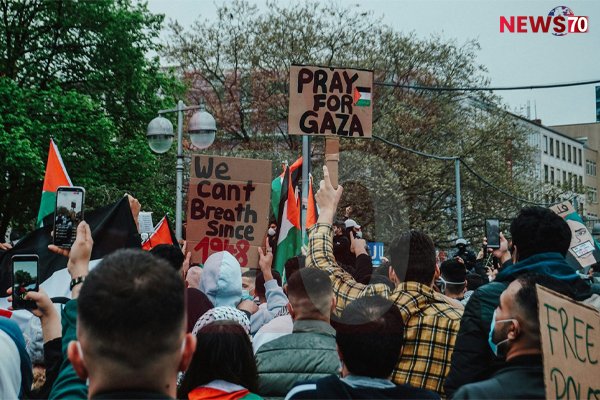
A week after a U.S.-brokered ceasefire between Israel and Hamas, renewed violence has threatened the fragile truce. Israeli airstrikes killed dozens in Gaza after a deadly Rafah attack on IDF troops, which Israel blamed on Hamas. Hamas denied involvement, citing lost communication with local cells. Despite pressure from the U.S. and ongoing mediation in Cairo, tensions remain high, and key issues like Hamas disarmament and Gaza’s future governance remain unresolved.
Ceasefire in Jeopardy as Gaza Violence Tests Israel-Hamas Truce
Just a week after U.S. President Donald Trump was welcomed in Israel for helping broker a ceasefire and facilitating an Israeli-Palestinian prisoner exchange, the fragile truce is already under severe strain.
On Sunday, the Israel Defense Forces (IDF) launched a wave of deadly airstrikes across Gaza, responding to the deaths of two Israeli soldiers in Rafah—a southern Gaza city. Israel blamed Hamas for the attack. However, Hamas denied involvement, claiming it had no communication with fighters in the area since March due to a loss of contact.
Following the Rafah attack, Israel halted the delivery of humanitarian aid to Gaza. Despite the tensions, pressure from Washington appears to have prevented a total collapse of the ceasefire, with border crossings reopening on Monday.
Mediators are now working intensely to stabilize the truce. U.S. special envoys Steve Witkoff and Jared Kushner have returned to the region, while Hamas representatives are engaged in talks with Egyptian mediators and other Palestinian factions in Cairo.
These discussions are expected to focus on phase two of President Trump's 20-point peace plan. This includes the deployment of an international stabilization force in Gaza, a phased withdrawal of IDF troops, and the disarmament of Hamas.
The resurgence of violence has devastated families on both sides. In Khan Younis, Shadi Abu Obeid mourned his 14-year-old son Mohammed, killed alongside two others in an Israeli strike on a tent in al-Mawasi. “I was always with him since the war began,” Shadi told the BBC. “Because of the ceasefire, I relaxed a bit and let him go out with his friends.”
Gazan hospitals reported at least 45 Palestinian deaths following Israeli strikes described by the IDF as targeting "dozens of Hamas terror sites." Among those killed were several members of Hamas’s military wing, including a commander, in a strike on a makeshift café in central Gaza. However, footage from the area showed civilian casualties, including children.
Trump’s envoys had been scheduled to meet Israeli Prime Minister Benjamin Netanyahu just before the violence flared. Speaking aboard Air Force One, Trump affirmed the truce remained intact and emphasized the need for “a very peaceful” outcome.
He acknowledged reports of internal unrest within Hamas, noting, “They’ve been doing some shooting,” but suggested rogue elements may be responsible rather than the central leadership.
Contrary to reports of clashes between Hamas and an Israel-allied militia in Rafah, the IDF stated Hamas had directly attacked Israeli forces with anti-tank missiles and gunfire. A government spokesperson said Israeli operations in Rafah were aimed at dismantling terrorist infrastructure and remained within the framework of the ceasefire.
Hamas maintained it had no operational links to Rafah for months and rejected responsibility for the attack.
Israeli commentators are now spotlighting flaws in the ceasefire deal. Amir Tibon, writing in Haaretz, called the agreement vague and riddled with loopholes, particularly regarding the fate of Hamas fighters caught behind Israeli lines at the time the truce was declared. Currently, the IDF controls nearly half of Gaza, separated by what’s referred to as the "Yellow Line."
In Israel Hayom, military analyst Yoav Limor characterized the Rafah clashes as a warning and urged the Israeli government to establish stricter guidelines in its dealings with Hamas.
Before leaving the U.S., Kushner and Witkoff revealed in a 60 Minutes interview that they broke with diplomatic protocol by holding direct talks with Hamas leaders in Sharm el-Sheikh. This step was taken to ensure the truce would hold after the return of Israeli hostages. Kushner said Trump was “very comfortable” with the approach and noted Hamas had shown willingness to return the bodies of Israeli hostages—16 of which are still missing. Hamas claimed to have recovered another body, which it intends to return when circumstances allow.
Israeli Defense Minister Israel Katz has since warned that any Hamas fighters beyond the Yellow Line must evacuate, adding that Hamas leadership would be held accountable for violations. To clarify the boundary, the IDF released footage of bulldozers placing yellow markers to visibly establish the demarcation.
Despite these efforts, violence continued. On Monday, Palestinian health officials reported that Israeli forces killed three people near Gaza City. The IDF claimed the individuals were "terrorists" who crossed into Israeli-controlled territory in Shejaiya.
As Israel’s parliament enters its winter session, internal political pressure is mounting on Netanyahu—especially with a Likud party leadership vote on the horizon. The prime minister has ordered “strong action” against truce violations but has stopped short of threatening a return to full-scale war.
On the Palestinian side, Hamas spokesman Mohammed Nazzal told Al Jazeera that the group has proposed a list of over 40 politically neutral technocrats to govern Gaza. However, in an interview with Reuters, Nazzal stated that Hamas still intends to oversee Gaza’s security during a transitional period—one of the most contentious issues in achieving a lasting peace.
U.S. Vice President JD Vance attempted to downplay the fragility of the situation, stating that the process would see “fits and starts,” but described the current agreement as “the best chance for a sustainable peace.”
Envoys Witkoff and Kushner are scheduled to continue their meetings in Cairo this week. Yet with major obstacles unresolved, it’s clear the path to permanent calm in Gaza remains uncertain.