
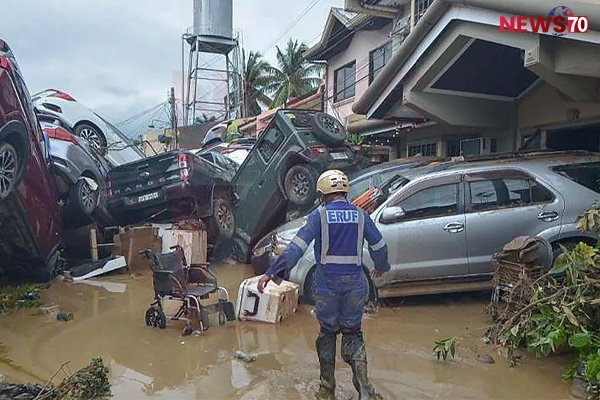
At least 66 people have died and over 400,000 displaced as Typhoon Kalmaegi (locally Tino) wreaked havoc across central Philippines, especially Cebu. The storm caused massive flooding, destroyed homes, and triggered a military helicopter crash that killed six crew members. Authorities declared a state of calamity, citing debris-blocked roads and rising floodwaters as major challenges. Kalmaegi is now moving toward Vietnam, bringing record rainfall.
Over 60 Dead as Typhoon Kalmaegi Devastates Central Philippines
At least 66 people have been killed and hundreds of thousands displaced after one of the year’s strongest typhoons tore through the central Philippines, officials said Wednesday.
Typhoon Kalmaegi, known locally as Tino, has inundated entire towns on the country’s most populated central island, Cebu, where 49 of the deaths were recorded. Another 26 people remain missing, a civil defence official told a local radio station.
Videos circulating online show residents stranded on rooftops as floodwaters engulfed communities, while cars and shipping containers were swept through the streets.
Among the confirmed fatalities are six crew members of a military helicopter that crashed on Mindanao island, south of Cebu, during a relief mission. The aircraft went down on Tuesday near Agusan del Sur and was one of four helicopters deployed to assist rescue efforts.
The Philippine Air Force said communication with the helicopter was lost shortly before the crash, triggering an immediate search and rescue operation. Later, a spokeswoman confirmed that six bodies, believed to be those of the pilot and crew, had been recovered.
Although Typhoon Kalmaegi has weakened since making landfall early Tuesday, it continues to bring winds exceeding 80 mph (130 km/h). The storm is expected to pass across the Visayas region before moving out over the South China Sea by Wednesday.
Rafaelito Alejandro, deputy administrator at the Office of Civil Defence, provided updated casualty figures during a live interview on radio station DZMM. He said rescuers are waiting for improved weather to deliver aid, noting, “The challenge is the debris and vehicles blocking the roads. There’s so much to clear.”
Cebu Governor Pamela Baricuatro described the situation as “unprecedented,” writing on Facebook: “We expected strong winds to be the main threat, but it’s the flooding that’s truly endangering lives. The floodwaters are devastating.”
Baricuatro declared a state of calamity in Cebu on Tuesday evening to facilitate emergency relief operations. Most of the fatalities were reportedly due to drowning, as torrents of muddy water swept down hillsides into urban areas.
Damage to homes and infrastructure across Cebu was severe, with small houses destroyed and streets buried under thick layers of mud. Rescue workers used boats to reach residents trapped inside their homes.
Don del Rosario, 28, from Cebu City, said he took shelter on an upper floor as floodwaters rose. “I’ve lived here all my life, and this is by far the worst storm I’ve ever experienced,” he told the AFP news agency.
According to the National Disaster Risk Reduction and Management Council, more than 400,000 people have been displaced by the typhoon.
The Philippines, struck by an average of 20 storms and typhoons annually, has faced a series of natural disasters in recent months.
Just last month, Super Typhoon Ragasa (locally Nando) and Typhoon Bualoi (locally Opong) hit the country in quick succession, killing over a dozen people and damaging crops and infrastructure.
Earlier this year, an unusually wet monsoon season caused widespread flooding, fueling public anger over incomplete and substandard flood-control systems blamed on corruption.
On 30 September, a 6.9-magnitude earthquake struck the central Philippines, killing dozens and leaving Cebu among the hardest-hit areas.
Typhoon Kalmaegi is now forecast to move toward Vietnam, where authorities are already reporting record-breaking rainfall.