
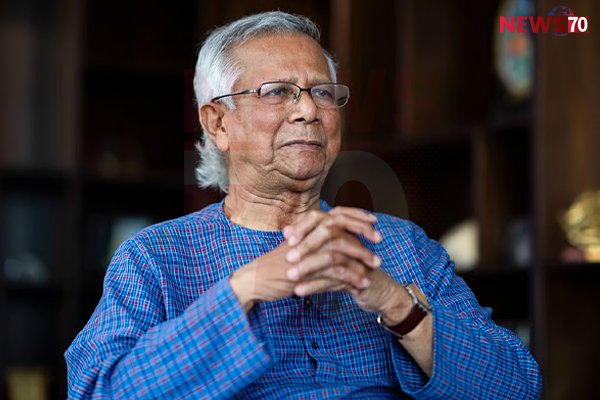
Business leaders have urged Chief Adviser Professor Muhammad Yunus to defer Bangladesh’s LDC graduation by three years, citing slow progress in trade, finance, and industry readiness. Yunus, however, emphasized self-reliance, urging all sectors to prepare for a sustainable and independent transition. The UN will assess Bangladesh’s readiness, with results expected by January 2026.
Yunus Calls for Self-Reliance as Businesses Urge Delay in LDC Graduation
Three leading business figures yesterday once again appealed to Chief Adviser (CA) Professor Muhammad Yunus to postpone Bangladesh’s graduation from the least developed country (LDC) category by at least three years—from November 2026—to allow for better preparation.
The appeal was made during a meeting at the CA’s office in Dhaka on the progress of LDC graduation readiness and the implementation of the “Smooth Transition Strategy” (STS), attended by most cabinet members.
Over the past several months, business leaders have repeatedly sought a deferment of the graduation timeline, saying the private sector is not yet fully prepared for a seamless transition.
“We have once again urged the government to delay the graduation, as we need additional time for preparation,” said Mahmud Hasan Khan, president of the Bangladesh Garment Manufacturers and Exporters Association (BGMEA).
He noted that improvements are still required in areas related to commerce and finance to ensure both a smooth graduation and the proper implementation of the STS, which serves as the roadmap for the process.
Speaking to The Daily Star by phone, Khan emphasized that two critical areas—the ease of doing business and the cost of doing business—demand significant progress, which would require at least three more years.
“True ease of doing business is still hindered by complex customs procedures,” he said, adding, “Additionally, high bank interest rates continue to pose a serious challenge for local enterprises.”
Dhaka Chamber of Commerce and Industry (DCCI) President Taskeen Ahmed echoed these concerns, noting that while the private sector is not opposed to LDC graduation, more time is essential to overcome existing challenges.
“The implementation of the STS has been very slow,” Ahmed said. “Bangladesh has yet to sign any major trade agreements with key partners, except for a preferential trade agreement with Bhutan.”
He further pointed out that the industrial sector is still grappling with an ongoing energy crisis, persistent weaknesses in the banking sector, and logistical bottlenecks.
At the same meeting, Bangladesh Association of Pharmaceutical Industries (BAPI) President Abdul Muktadir stressed that the pharmaceutical sector could gain significant benefits if the graduation were postponed for at least three years.
Following the discussions, CA’s Press Secretary Shafiqul Alam briefed the media at the Foreign Service Academy in Dhaka, saying Professor Yunus was committed to ensuring a smooth and sustainable transition before the graduation takes effect.
Alam said the Chief Adviser underscored that the government’s foremost goal is to achieve LDC graduation through self-reliance rather than external dependence.
He quoted Yunus as urging all sectors to focus on building a self-sufficient and resilient economy as Bangladesh moves toward graduation.
“We must not depend on others. We have to stand on our own feet and eliminate all forms of dependency,” Yunus was quoted as saying. “It must be clear to everyone that we no longer wish to rely on others.”
“Regardless of the deadline, we must achieve self-reliance,” Yunus added. “To be self-reliant, we must rely on our intelligence, hard work, and continuous effort.”
He continued, “Even if the journey is difficult, there is joy in this struggle. A new Bangladesh means a self-reliant Bangladesh.”
By the end of last month, Professor Yunus had requested UN Under-Secretary-General Rabab to conduct an assessment of Bangladesh’s readiness for graduation. The United Nations agreed to support the assessment, which is scheduled to begin within a month and conclude by mid-January 2026.
Alam also informed that during the meeting, it was announced that the new import policy for 2026–2028 will be unveiled soon.